
This article provides readers with key knowledge from Module 1 – Quantitative Methods in the CFA Level 1 program.
Inhaltsübersicht
[LOS 1.a] Interpreting Interest Rates and Their Components
1. Interpretation der Zinssätze
An interest rate is the amount a lender charges a borrower for the use of money, expressed as a percentage (%) of the principal.
In finance, interest rates can be interpreted in three main ways:
- Discount Rate:
The rate used by investors to discount future cash flows to their present value. - Opportunity Cost:
The value that investors forgo when choosing one investment over another (e.g., saving or investing in alternative assets). - Required Rate of Return:
The minimum return investors demand to compensate for the risk of an investment.
2. Komponenten der Zinssätze
The required rate of return can be broken down into several components:
Required Rate of Return = Nominal Risk-Free Rate + Default Risk Premium + Liquidity Risk Premium + Maturity Risk Premium
Where:
- Nominal Risk-Free Rate = Real Risk-Free Rate + Expected Inflation
Explanation of Each Component:
- Real Risk-Free Rate:
The return on a risk-free investment in a world with no inflation. - Expected Inflation:
Compensation for the anticipated decline in purchasing power. - Default Risk Premium:
Additional return required to compensate investors for the risk that a borrower may fail to meet obligations. - Liquidity Risk Premium:
Compensation for the risk of not being able to quickly convert an investment into cash without significant loss. - Maturity Risk Premium:
Compensation for the risk associated with longer investment horizons, where interest rate fluctuations can significantly impact asset prices.
Wichtiger Hinweis
Government Treasury securities (e.g., T-bills) are typically considered to reflect the nominal risk-free rate, as they already incorporate expected inflation.
[LOS 1.b] Measuring and Interpreting Returns
1. Messung der Rendite über einen einzelnen Zeitraum
- Holding Period Return (HPR):
The total return earned over a specific holding period.
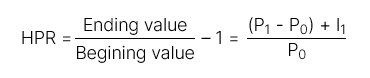
It includes:
- Capital gains (or losses)
- Income (such as dividends or interest)
2. Messung der Rendite über mehrere Zeiträume
| Return Type | Formula | Definition |
| Holding Period Return (HPR) | R = (1 + R1)(1 + R2)…(1 + Rn) – 1 | The return earned over a holding period longer than one year. |
| Arithmetic Mean Return |  | The average return over a given number of periods. It is an unbiased estimate of the expected average return. |
| Geometric Mean Return |  |  Used when periodic returns vary. It represents the compound average growth rate over multiple periods. Used when periodic returns vary. It represents the compound average growth rate over multiple periods. |
| Harmonic Mean Return | Harmonic mean: Harmonic mean return: Harmonic mean return: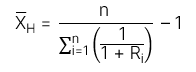 | The harmonic mean is a weighted average where weights are inversely proportional to the magnitude of observations. It is commonly used in investment management to calculate the average cost of shares purchased over time. |
[LOS 1.c] Comparing Money-Weighted and Time-Weighted Rates of Return. Evaluating Portfolio Performance
| Geldgewichtete Rendite – MWR | Zeitgewichtete Rendite – TWR | |
| Definition | MWR ist die Abzinsungsrate die den Barwert der Cashflows mit dem Barwert der Cashabflüsse gleichsetzt. | TWR ist im Wesentlichen die geometrische Mittelrendite die über den gesamten Investitionszeitraum berechnet wird. |
| Regel | MWR Berechnungsschritte Schritt 1: Alle Cashflows identifizieren: Cashzuflüsse: Alle Einzahlungen auf das Konto Cashabflüsse: Alle Abhebungen vom Konto Schritt 2: Calculate the IRR dieser Cashflows zur Bestimmung der MWR. | Schritt 1: Bestimmen Sie den Portfoliowert unmittelbar vor jedem Cashzufluss oder -abfluss. Schritt 2: Teilen Sie den gesamten Investitionszeitraum in kleinere Unterperioden basierend auf den Cashflow-Daten auf. Calculate the Holding Period Return (HPR) für jede Unterperiode. Schritt 3: Berechnen Sie die Gesamtrendite durch das Aufzinsen der Unterperiodenrenditen: TWR=(1+HPR1)(1+HPR2)⋯(1+HPRn)−1 Hinweis: Wenn der Investitionszeitraum ein Jahr überschreitet, verwenden Sie die geometrische Mittelrendite um TWR zu annualisieren. |
In der Investmentmanagementbranche, die Time-Weighted Rate of Return (TWR) is generally preferred because it is not affected by the timing of cash inflows and outflows.
If funds are added to a portfolio during unfavorable periods, the value calculated using the Money-Weighted Rate of Return (MWR) tends to be lower (MWR < TWR). Conversely, if funds are added during favorable periods, the value calculated using MWR tends to be higher (MWR > TWR).
[LOS 1.d] Calculating and Interpreting Other Measures of Return and Their Applications
| Types of Returns | Formula | |
| Gross return and Net return | Gross return | The total return before management fees and expenses. |
| Net return | The total return after deducting management fees and expenses. | |
| Pretax and After-tax Nominal Return | Pretax return | The portion of return before taxes are applied. |
| After-tax return | The portion of return after taxes have been deducted. | |
| Real Return and Nominal Return | Nominal Return |  Nominal Return Nominal ReturnBeinhaltet: Risk-free rate (Rf) Inflation (π) Risk premium (RP) =>> Nominal return reflects the total return without adjusting for inflation. |
| Real Return | 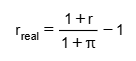 Real Return Variablen: r: Nominalrendite r_real: Realrendite π: Inflationsrate =>> Die Realrendite ist die Rendite nach Anpassung an die Inflation, die den tatsächlichen Anstieg der Kaufkraft darstellt. | |
| Hebelrendite |  Investoren können Hebel nutzen durch: Geld leihen Derivate verwenden =>> Dies verstärkt sowohl potenzielle Gewinne als auch Verluste. Berechnungskonzept: Gewinn oder Verlust wird basierend auf dem tatsächlichen investierten Kapital des Investors (Eigenkapital) gemessen, nicht dem Gesamtwert der Vermögenswerte. | |
 English
  German
  French
  Spanish
  Portuguese (Portugal)
  Italian
  Dutch
Dutch  Turkish
  Polish
  Chinese (China)
  Chinese (Hong Kong)
  Chinese (Taiwan)
  Korean
  Japanese
  Indonesian
  Portuguese (Brazil)
  Romanian
  Bulgarian
  Greek
Greek  Hungarian
  Czech
Czech  Finnish
  Swedish
  Danish
  Thai
Thai  Vietnamese