
This article provides readers with key knowledge from Module 1 – Quantitative Methods in the CFA Level 1 program.
目录
[LOS 1.a] Interpreting Interest Rates and Their Components
1. Interpreting Interest Rates
An interest rate is the amount a lender charges a borrower for the use of money, expressed as a percentage (%) of the principal.
In finance, interest rates can be interpreted in three main ways:
- Discount Rate:
The rate used by investors to discount future cash flows to their present value. - Opportunity Cost:
The value that investors forgo when choosing one investment over another (e.g., saving or investing in alternative assets). - Required Rate of Return:
The minimum return investors demand to compensate for the risk of an investment.
2. Components of Interest Rates
The required rate of return can be broken down into several components:
Required Rate of Return = Nominal Risk-Free Rate + Default Risk Premium + Liquidity Risk Premium + Maturity Risk Premium
Where:
- Nominal Risk-Free Rate = Real Risk-Free Rate + Expected Inflation
Explanation of Each Component:
- Real Risk-Free Rate:
The return on a risk-free investment in a world with no inflation. - Expected Inflation:
Compensation for the anticipated decline in purchasing power. - Default Risk Premium:
Additional return required to compensate investors for the risk that a borrower may fail to meet obligations. - Liquidity Risk Premium:
Compensation for the risk of not being able to quickly convert an investment into cash without significant loss. - Maturity Risk Premium:
Compensation for the risk associated with longer investment horizons, where interest rate fluctuations can significantly impact asset prices.
Important Note
Government Treasury securities (e.g., T-bills) are typically considered to reflect the nominal risk-free rate, as they already incorporate expected inflation.
[LOS 1.b] Measuring and Interpreting Returns
1. Measuring Return Over a Single Period
- Holding Period Return (HPR):
The total return earned over a specific holding period.
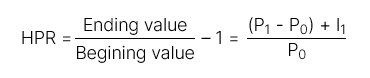
It includes:
- Capital gains (or losses)
- Income (such as dividends or interest)
2. Measuring Return Over Multiple Periods
| Return Type | Formula | Definition |
| Holding Period Return (HPR) | R = (1 + R1)(1 + R2)…(1 + Rn) – 1 | The return earned over a holding period longer than one year. |
| Arithmetic Mean Return |  | The average return over a given number of periods. It is an unbiased estimate of the expected average return. |
| Geometric Mean Return |  |  Used when periodic returns vary. It represents the compound average growth rate over multiple periods. Used when periodic returns vary. It represents the compound average growth rate over multiple periods. |
| Harmonic Mean Return | Harmonic mean: Harmonic mean return: Harmonic mean return: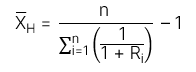 | The harmonic mean is a weighted average where weights are inversely proportional to the magnitude of observations. It is commonly used in investment management to calculate the average cost of shares purchased over time. |
[LOS 1.c] Comparing Money-Weighted and Time-Weighted Rates of Return. Evaluating Portfolio Performance
| Money-weighted rate of return – MWR | Time-weighted rate of return – TWR | |
| Definition | MWR is the discount rate that equates the present value of cash inflows with the present value of cash outflows. | TWR is essentially the geometric mean return calculated over the entire investment period. |
| Rule | MWR Calculation Steps Step 1: Identify all cash flows: Cash inflows: All contributions into the account Cash outflows: All withdrawals from the account Step 2: 計算 IRR of these cash flows to determine the MWR. | Step 1: Determine the portfolio value immediately before each cash inflow or outflow. Step 2: Break the total investment period into smaller sub-periods based on cash flow dates. 計算 Holding Period Return (HPR) for each sub-period. Step 3: Compute the overall return by compounding sub-period returns: TWR=(1+HPR1)(1+HPR2)⋯(1+HPRn)−1 注意: If the investment period exceeds one year, use the geometric mean return to annualize TWR. |
In the investment management industry, the Time-Weighted Rate of Return (TWR) is generally preferred because it is not affected by the timing of cash inflows and outflows.
If funds are added to a portfolio during unfavorable periods, the value calculated using the Money-Weighted Rate of Return (MWR) tends to be lower (MWR < TWR). Conversely, if funds are added during favorable periods, the value calculated using MWR tends to be higher (MWR > TWR).
[LOS 1.d] Calculating and Interpreting Other Measures of Return and Their Applications
| Types of Returns | Formula | |
| Gross return and Net return | Gross return | The total return before management fees and expenses. |
| Net return | The total return after deducting management fees and expenses. | |
| Pretax and After-tax Nominal Return | Pretax return | The portion of return before taxes are applied. |
| After-tax return | The portion of return after taxes have been deducted. | |
| Real Return and Nominal Return | Nominal Return |  Nominal Return Nominal ReturnIncludes: Risk-free rate (Rf) Inflation (π) Risk premium (RP) =>> Nominal return reflects the total return without adjusting for inflation. |
| Real Return | 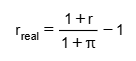 Real Return Variables: r: Nominal return r_real: Real return π: Inflation rate =>> Real return is the return after adjusting for inflation, representing the true increase in purchasing power. | |
| Leverage Return |  Investors can use leverage by: Borrowing money Using derivatives =>> This amplifies both potential gains and losses. Calculation concept: Profit or loss is measured based on the investor’s actual invested capital (equity), not the total asset value. | |
 English
  German
  French
  Spanish
  Portuguese (Portugal)
  Italian
  Dutch
Dutch  Turkish
  Polish
  Chinese (China)
  Chinese (Hong Kong)
  Chinese (Taiwan)
  Korean
  Japanese
  Indonesian
  Portuguese (Brazil)
  Romanian
  Bulgarian
  Greek
Greek  Hungarian
  Czech
Czech  Finnish
  Swedish
  Danish
  Thai
Thai  Vietnamese